
Table of Contents
- Why Seasonal Fragrance Rotation Works Better with Samples
- What You'll Need Before You Start Rotating
- Step 1: Map Your Scent Profile by Season
- Step 2: Choose Fragrance Sample Sets for Beginners
- Step 3: Test Samples Across Real Weather, Not Just One Day
- Step 4: Learn How to Store Perfume Samples Properly
- Step 5: Decide Between a Travel Spray vs Full Bottle
- Step 6: Rotate on a Schedule That Matches Your Wardrobe
- Common Mistakes to Avoid with Seasonal Fragrance Rotation
- Frequently Asked Questions
Last Updated: September 29, 2026
Why Seasonal Fragrance Rotation Works Better with Samples
Seasonal fragrance rotation is the practice of switching the scents you wear as the weather changes, and it works best when you test each one in a small sample size first. Temperature shifts how a fragrance smells on your skin, so a scent you loved in January can feel heavy in July. This guide from Pocket Scent ATL walks you through building a rotation without wasting money on full bottles you never finish.
Here's the core idea: your nose and your skin both respond to heat. Warm air pushes a fragrance's base notes forward, while cold air slows them down. That single fact explains why so many people buy a bottle in one season and abandon it in the next.
The good news is that testing costs very little. A 2 ml sample spray gives you several wears, which is enough to learn how a scent behaves before you commit.
How Temperature Changes What You Smell
Heat amplifies everything. When your skin is warm, the lighter top notes burn off faster and the heavier base notes rise to the surface.
That means a sweet, spicy fragrance can turn syrupy on a hot afternoon. The same scent in cool air stays balanced and controlled.
Cold weather does the opposite. It mutes bright citrus and fresh aqua notes, which is why a summer scent can smell thin and flat in winter.
The Cost of Skipping the Sample Step
Most people who regret a fragrance purchase skipped testing. They bought a full bottle based on a paper strip or a single spray in a store.
A paper strip tells you almost nothing about how a scent will dry down on your skin. Skin chemistry, body heat, and humidity all change the result.
Sampling first is the cheapest form of insurance in this hobby. You spend a little, learn a lot, and only buy full size when you're sure.
What You'll Need Before You Start Rotating
Getting organized takes about 20 minutes and almost no money. You need a way to track what you test, a cool dark place to store samples, and a rough plan for which seasons you're shopping for.
Start with these basics:
- A small notebook or notes app for scent impressions
- A cool, dark drawer or box for storage
- A few 2 ml sample sprays per season you want to cover
- Labels so you can tell vials apart at a glance
- A calendar reminder to revisit your rotation each season
One common mistake is testing five fragrances in one sitting. Your nose stops telling them apart after about three. Space your testing out over several days instead.
Step 1: Map Your Scent Profile by Season
Your scent profile is the mix of fragrance families you naturally reach for. Mapping it by season keeps you from buying the same type of scent over and over.
Most people fall into two or three families. Once you know yours, choosing samples gets much faster.
Spring and Summer: Fresh, Citrus, Aqua
Warm-weather scents lean on top notes: citrus, green leaves, light florals, and marine accords. These notes feel clean and lift easily in heat.
Dolce & Gabbana Light Blue is a classic example. Its Sicilian lemon, apple, and cedar blend stays bright and easy to wear in warm air. For a sense of how it performs, see the Fragrance Foundation's guide to fragrance families overview of how scent families are classified.
Look for words like fresh, citrus, aquatic, and green when you browse.
Fall and Winter: Warm, Woody, Spiced
Cool-weather scents rely on base notes: woods, resins, vanilla, amber, and spice. These notes need warmth to open up, which is why they shine in fall and winter.
Armaf Club de Nuit Intense Man fits this slot well. Its smoky birch, rose, and musk base reads bold and confident on cool evenings.

Look for words like woody, smoky, amber, spicy, and oriental.
Step 2: Choose Fragrance Sample Sets for Beginners
Fragrance sample sets for beginners work best when they mix families instead of repeating one. A good set lets you compare a fresh scent against a warm one in the same week.
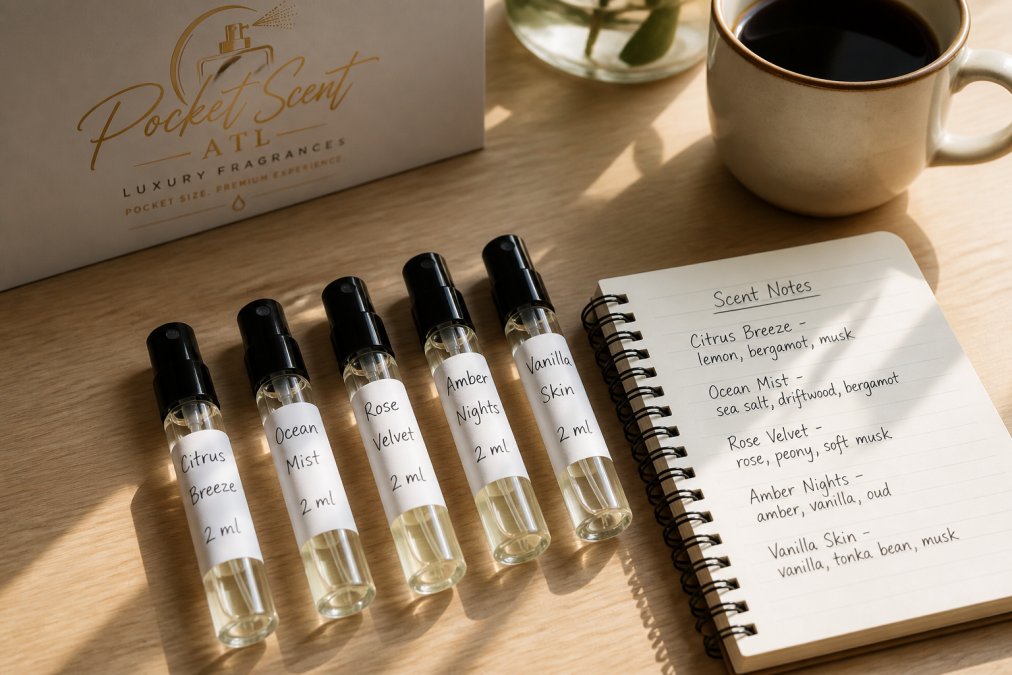
Pocket Scent ATL offers a build-your-own discovery box with five 2 ml glass sample sprays, which comes to roughly 10 ml of fragrance total. You pick the five, so you can cover spring, summer, fall, and winter in one order.

If you already know which family you like, a single 2 ml sample of one fragrance is a smarter starting point. Try it for a week before adding more.
Step 3: Test Samples Across Real Weather, Not Just One Day
A fragrance needs at least three wears in different conditions before you can judge it. One day tells you how it opens. Three days tell you how it lives.
Wear each sample on a normal day, not a special occasion. Go to work, run errands, sit in traffic. That's when you learn whether a scent annoys you by hour four.
Track these four things each time:
- How it smells in the first 15 minutes
- How it smells after an hour, once it settles
- How long it lasts before you can't detect it
- Whether you still like it at the end of the day
That last one matters most. Plenty of fragrances smell great for an hour and tiresome by dinner.
Step 4: Learn How to Store Perfume Samples Properly
Knowing how to store perfume samples properly is what keeps them usable for months. Heat, light, and air are the three things that break a fragrance down. But storage is only half the job, once you have more than a handful of 2 ml vials, you also need a system for tracking what you own so nothing gets lost or wasted.
The Storage Basics That Actually Matter
Store samples in a cool, dark place, away from windows and radiators. A closed drawer or a box in a closet works well. Bathrooms are a poor choice because of the heat and humidity swings from showers.
Keep vials upright so they don't leak, and tighten the caps after each use. If you're holding a larger collection, a small labeled box keeps things tidy and stops you from losing track of what you own.
Temperature swings matter more than most people realize. A sample that sits in a hot car for an afternoon can shift in scent, and once a fragrance turns, there's no bringing it back. The same goes for a sunny windowsill, a few weeks of direct light can dull a delicate citrus top note noticeably.
A Simple Inventory System for Small Vials
Most guides tell you to buy samples. Very few tell you what to do once you have twenty of them. Here's a lightweight system that works for beginners and keeps a collection from turning into clutter.
1. Label every vial the day it arrives. Write the fragrance name, the house, and the date you received it. A strip of masking tape and a fine-tip marker is enough. If you decant into your own 2 ml sprayers, label those too, unlabeled vials are the number one reason samples get tossed unused.
2. Assign each vial a status. A simple three-tier tag keeps decisions easy:
Build Your Own Five-Scent Discovery Box →
- Testing, you've worn it once or twice and haven't decided yet
- Keep, you like it and want it in your rotation
- Pass, you've given it a fair shot and it isn't for you
3. Log four fields per sample. In a notebook or a notes app, track the name, the season you tested it in, your one-line impression, and the status. That's it. Four fields is enough to jog your memory months later when you're deciding what to reorder.
4. Review the box at each season change. When the weather turns, pull out the 'Pass' vials and set them aside. You can gift them to a friend, use them to freshen a drawer, or check whether your local recycling program accepts small glass. Empty glass vials are recyclable in many curbside programs; plastic sprayers and caps often are not, so check your local guidelines before tossing them in the bin.
5. Cap your active testing set. A common pattern among hobbyists is to keep no more than five to seven samples in active rotation at once. More than that and your nose loses track, your notes get muddled, and vials sit half-used past their best window.
Why This Matters for Waste
Small vials add up. A dozen 2 ml samples is a modest amount of glass and plastic, but a collection that grows for years without a system tends to produce a lot of half-used vials that eventually get thrown out. Labeling, logging, and reviewing at each season change keeps you from re-buying scents you already tested and from letting good samples expire in a drawer.
If you're building a rotation through Pocket Scent ATL, our 2 ml samples and 10 ml travel sprays are sized so you can finish what you start. Browse the build-your-own discovery box to pick a set that fits the seasons you're shopping for, and keep the box itself as your storage tray.
Step 5: Decide Between a Travel Spray vs Full Bottle
The travel spray vs full bottle decision comes down to how often you'll wear the scent and whether you've finished testing it. A 10 ml travel spray is the middle step most people skip.
Here's how the three sizes compare:
| Size | Best For | Commitment Level |
|---|---|---|
| 2 ml sample | First-time testing | Lowest |
| 5 ml pocket spray | Occasional wear, bags | Low |
| 10 ml travel spray | Regular wear, travel | Medium |
| Full bottle | Proven favorites | Highest |
A 10 ml travel spray holds enough for weeks of regular wear. It's also the easiest size to carry. If you finish a travel spray and still want more, that's your signal to buy full size.
YSL Libre Eau de Parfum is a good example of a scent worth the travel-spray step. Its lavender, orange blossom, and vanilla blend works across spring, fall, and winter, so you'll get real use out of it before deciding.

Step 6: Rotate on a Schedule That Matches Your Wardrobe
A rotation schedule keeps your collection balanced instead of letting one bottle dominate. Most people do well with a simple two-season split, but the more useful skill is knowing when a sample has earned a permanent spot, and when it's time to let it go.
The Basic Two-Season Split
Try this approach:
- Warm months: two or three fresh scents in reach
- Cool months: two or three warm scents in reach
- Year-round: one or two flexible scents you wear anytime
- Swap dates: first cool snap in fall, first warm week in spring
Don't force it by the calendar alone. Weather varies, and your own mood matters. The goal is a wardrobe balance that feels natural, not a strict rulebook.
The Sample-to-Full-Bottle Decision Framework
This is the step most rotation guides skip. You've tested a sample across several wears. How do you decide whether to buy full size, step up to a 10 ml travel spray, or move on?
Ask these four questions:
1. Did you finish the sample? If a 2 ml vial lasted you several wears and you were sorry when it ran out, that's a strong signal. If it's still half full after a month, that's a signal too, just not the one you want.
2. Did you reach for it without thinking? Scents that earn a full bottle are usually the ones you grab on autopilot, not the ones you have to talk yourself into wearing.
3. Does it work in more than one season? A scent that only shines in a narrow weather window is a better fit for a 10 ml travel spray than a full bottle. A scent that works across spring, fall, and winter earns more shelf space because you'll actually use it.
4. Would you miss it if it were gone? This is the simplest test. If the answer is no, pass the sample along and put the money toward something you'd reach for more often.
A practical rule of thumb: finish a 2 ml sample, then buy a 10 ml travel spray, then buy full size only after the travel spray is gone. That three-step ladder keeps you from buying bottles you'll never finish, and it gives each scent two honest chances to prove itself.
What to Keep in Rotation vs. What to Retire
At each season change, do a quick review:
- Promote, samples you finished and loved move up to a travel spray or full bottle
- Hold, samples you liked but didn't finish stay in the box for another season
- Retire, samples you tested fairly and didn't reach for get passed along or recycled
Retiring a sample isn't a failure. It's the system working. The whole point of small sizes is that you can say no cheaply.
A Note on Fragrance Fatigue
Rotating on a schedule also helps with olfactory fatigue, the way your nose tunes out a scent you wear often. Switching between two or three scents across a week keeps each one fresh to your nose. If you've been wearing the same fragrance daily and it seems to fade by mid-afternoon, try rotating it out for a few days before you assume it's gone. It usually isn't.
When you're ready to build or refresh a rotation, Pocket Scent ATL carries authentic designer, niche, and Middle Eastern fragrances in 2 ml samples, 10 ml travel sprays, and full-size bottles. Start with samples, let the three-step ladder guide your next move, and find your signature scent one vial at a time.
Common Mistakes to Avoid with Seasonal Fragrance Rotation
The biggest mistake is blind buying a full bottle after one spray. A single wear can't tell you how a scent behaves over a full day.
Other traps to watch for:
- Testing too many fragrances at once and losing your sense of smell
- Judging a scent only by its opening notes
- Storing samples in a hot car or sunny room
- Buying full size before finishing a sample or travel spray
- Ignoring olfactory fatigue, which makes you think a scent faded when it hasn't
That last one catches almost everyone. Your nose tunes out scents you wear often, so a fragrance may still be projecting while you can barely detect it. Ask someone else before you assume it's gone.
Building a rotation takes a little patience, but it saves you from a shelf full of bottles you never reach for. Start with samples, test in real weather, and let your own skin decide what stays.
Pocket Scent ATL carries authentic designer, niche, and Middle Eastern fragrances in 2 ml samples, 10 ml travel sprays, and full-size bottles, so you can move at your own pace. Our team can help you narrow down which scents suit each season, and our International Fragrance Association's ingredient standards aligned sourcing keeps things straightforward.
Explore the men's and women's collections, or build your own five-scent discovery box and find your signature scent one sample at a time.
Frequently Asked Questions
How many fragrances should be in a seasonal rotation?
Most people find three to five fragrances per season works well: one everyday scent, one for evenings, and one or two for special occasions. Starting with a five-scent discovery box lets you test that range without committing to full bottles. A seasonal fragrance rotation with more than six options often means some bottles sit untouched long enough to lose their top notes.
Why is it better to use samples before buying full bottles?
A fragrance can smell completely different on your skin than on a paper strip or in the bottle. Skin chemistry, body heat, and the weather all shift how top notes, heart notes, and base notes develop. A 2 ml sample gives you several wears to see the full dry down before you spend full-bottle money on something that may not suit you.
How do you store fragrance samples to keep them fresh?
Keep samples away from direct sunlight, heat, and humidity. A closed drawer or a box in a cool room works better than a bathroom shelf. Store vials upright so the sprayer stays clean, and keep them in their original labeled packaging if possible. Most samples stay true for one to three years when stored this way, though citrus-forward scents can fade sooner.
How often should you rotate your perfume collection?
A practical rhythm is to swap your active rotation at the start of each season, then adjust mid-season if the weather shifts. If you live somewhere with mild winters, you may only need two rotations per year. The key is to match your scent to the temperature and occasion, not to a calendar date. Revisit your samples each season to see which ones still feel right.
0 comments