
Table of Contents
- Middle Eastern Perfume vs Western Perfume: The Short Answer
- Side-by-Side Comparison: Notes, Concentration, and Performance
- What Is Oud Perfume, and Why It Defines Middle Eastern Blends
- A Fragrance Concentration Guide: Eau de Toilette, Eau de Parfum, and Perfume Oil
- Longevity, Sillage, and How Skin Chemistry Changes Everything
- How to Layer Fragrances: Blending Eastern and Western Styles
- Wearing Potent Scents to Work: A Professional Etiquette Guide
- Sourcing, Sustainability, and What Authenticity Actually Means
- Which Style Fits You? A Decision Framework
- Conclusion
- Frequently Asked Questions
Last Updated: September 23, 2026
Middle Eastern Perfume vs Western Perfume: The Short Answer
The biggest difference between middle eastern perfume vs western perfume comes down to ingredients and intensity. Middle Eastern perfumes lean on oud, saffron, amber, and resins with high oil concentrations, while Western perfumes favor citrus, florals, and lighter synthetic molecules built for broad appeal. The "better" style depends entirely on what you want a fragrance to do.
A quick note on terminology before we go further: Middle Eastern perfume refers to fragrance traditions rooted in the Arabian Peninsula and broader region, built around resinous, spicy, and woody materials like oud, attar, rose, and saffron. Western perfume refers to the European and American tradition, which leans on citrus, florals, and clean musk structures.
Neither style is objectively superior. They solve different problems.
Here's what most guides get wrong: they frame this as "strong versus weak" when the real divide is composition philosophy. Below, we'll break down notes, concentration, longevity, skin chemistry, and how to wear each style without overwhelming a room.
Side-by-Side Comparison: Notes, Concentration, and Performance
Here's the direct comparison most shoppers want before they buy anything.
| Feature | Middle Eastern Perfume | Western Perfume |
|---|---|---|
| Dominant notes | Oud, saffron, rose, amber, musk | Citrus, florals, clean musk, light woods |
| Base notes | Resins, woods, animalic accords | Musk, cedar, ambroxan, vanilla |
| Typical concentration | Higher oil load, often EDP or oil | Ranges from EDT to EDP |
| Longevity | Often 8+ hours on many skin types | Varies widely, often 4-7 hours |
| Sillage | Strong, room-filling | Moderate to soft |
| Price entry point | Frequently lower for similar depth | Often higher for comparable complexity |
| Best for | Evenings, cool weather, statement wear | Daytime, office, warm weather |
The table tells you the pattern. The nuance lives underneath it.
What Each Style Gets Right
Middle Eastern houses excel at complexity. A single spray can move through saffron, rose, and oud over several hours, and the dry down often smells richer than the opening. Western perfumery excels at clarity. A well-made Western citrus or aquatic scent reads clean and immediately likeable, which is why so many of them become office staples.
Where Each Style Falls Short
Middle Eastern blends can overwhelm a small room if you spray too much. Western fragrances sometimes fade faster than buyers expect, especially lighter EDTs. Neither is a flaw in the fragrance; both are trade-offs baked into the style.
What Is Oud Perfume, and Why It Defines Middle Eastern Blends
Oud perfume is a fragrance built around agarwood resin, a dark, woody material produced when certain trees respond to natural infection (pubmed.ncbi.nlm.nih.gov). It smells smoky, leathery, and slightly sweet, and it anchors many Middle Eastern compositions.
Oud isn't a single note so much as a family. Real oud varies by origin and age, and much of what's sold today uses synthetic or blended oud accords to keep costs reasonable. That's not a dirty secret; it's how the industry keeps oud accessible.
You'll also see attar, a traditional oil-based format where fragrance is distilled or blended into a carrier oil rather than alcohol. Attars sit close to the skin and evolve slowly, which is part of why Middle Eastern perfumery feels so different from a typical Western spray.
If you want to test the style without committing, a Middle Eastern oud-forward scent like Lattafa Asad Elixir blends saffron, tobacco, and frankincense into a warm, resinous dry down. It's a fair introduction to how these accords behave on skin.

A Fragrance Concentration Guide: Eau de Toilette, Eau de Parfum, and Perfume Oil
Concentration tells you how much fragrance material sits in the bottle. The carrier tells you how that material behaves once it hits your skin. Most guides cover the first and skip the second, which is why the Middle Eastern vs Western comparison often feels incomplete.
Here's the practical breakdown of the three formats you'll see most often:
- Eau de Toilette (EDT): A lighter concentration of fragrance oil in an alcohol base. Brighter, fresher, and generally easier to wear in heat. Many EDTs benefit from a reapply by late afternoon.
- Eau de Parfum (EDP): A higher concentration of fragrance oil in an alcohol base. Richer and typically longer-lasting than an EDT, though the exact ratio varies by house.
- Perfume oil / attar: Little to no alcohol. The fragrance material is carried in a skin-friendly oil, so it sits closer to the skin and unfolds more slowly than an alcohol spray.
Why the Carrier Matters as Much as the Concentration
Alcohol is volatile. When you spray an EDT or EDP, the alcohol flashes off within seconds and lifts the top notes into the air. That's why Western sprays feel immediate: you smell the citrus, the aquatic accords, the bright opening right away. The trade-off is that volatile top notes also disappear faster, which is part of why lighter Western compositions can read as fleeting.
Oil is not volatile in the same way. A traditional attar or perfume oil doesn't bloom on contact. It warms against your skin and releases scent gradually, often starting close and expanding over the first 15 to 30 minutes. Middle Eastern oil-based formats lean into this: the opening can feel quiet, then the heart and base arrive and stay for hours. If you judge an oil in the first 60 seconds, you're judging the wrong phase.
This is also why the same note can smell different across formats. Oud in an alcohol spray tends to read sharper and more diffusive up front. Oud in an oil reads rounder and more resinous, because the carrier slows the release and lets the heavier molecules dominate.
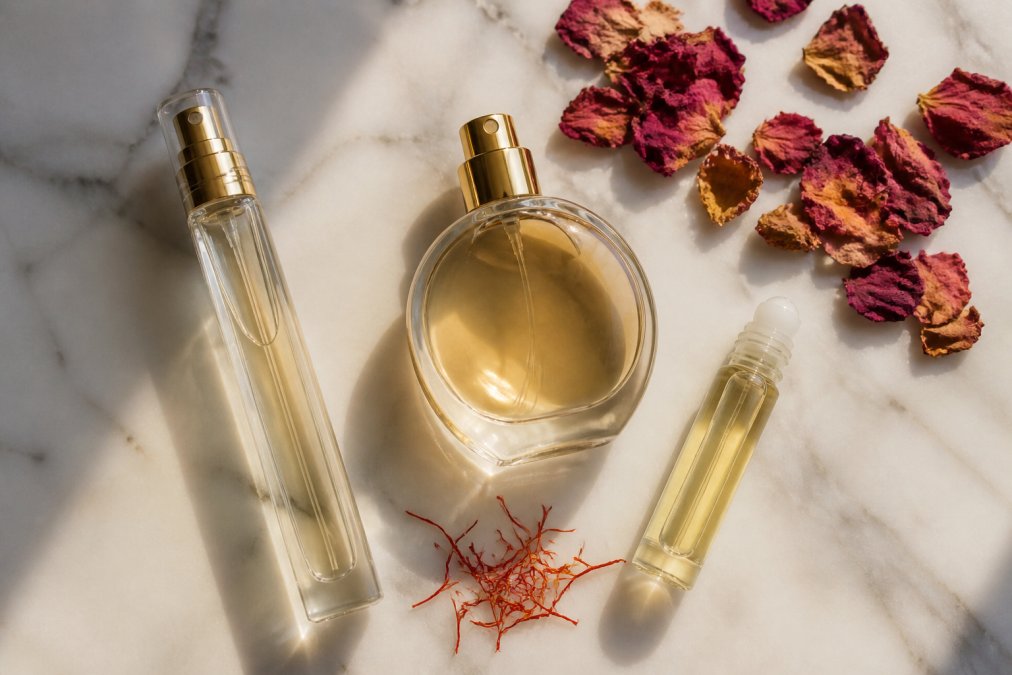
Concentration isn't a quality ranking, and the label alone won't tell you how a fragrance will perform. The carrier, the ingredient quality, and your own skin chemistry all factor in.
If you want to feel the difference for yourself, a 2 ml sample of a Western EDP is a great way to understand how carrier chemistry changes the experience on your own skin.

Longevity, Sillage, and How Skin Chemistry Changes Everything
Skin chemistry decides how any fragrance performs on you. Dry skin tends to hold scent for less time than oilier skin, and body heat, humidity, and even what you ate can shift how notes read.
Longevity is how long a fragrance stays detectable. Sillage is the trail it leaves behind you. Projection is how far it reaches from your body at any moment. These three behave differently on every person, which is why two people wearing the same bottle can have completely different experiences.
This is also why blind buying is risky. A fragrance that lasts all day on one person may fade in three hours on another. Sampling on your own skin, at your own body temperature, is the only way to know.
Club de Nuit Intense Man EDT →
At Pocket Scent ATL, we stock 2 ml samples and 10 ml travel sprays alongside full bottles to help you test first, then commit.
How to Layer Fragrances: Blending Eastern and Western Styles
Layering is the fastest way to get the best of both worlds. The goal is to combine a heavier base with a lighter top, not to stack two loud scents and hope for the best.
A simple method:
- Start with the denser fragrance as your base. Apply to pulse points.
- Wait two to three minutes for it to settle.
- Add the lighter fragrance on top, one or two sprays maximum.
- Step outside and let the combination breathe before judging it.
For example, a fresh aquatic Western scent layered over a warm oud base gives you brightness up front and depth underneath. A citrus EDT over a saffron-forward Middle Eastern blend works the same way in reverse.
Wearing Potent Scents to Work: A Professional Etiquette Guide
Strong fragrances belong in offices too, with adjusted application. The rule is simple: reduce the spray count, not the fragrance.
- One to two sprays maximum for oud, amber, or heavy EDPs in shared spaces.
- Apply to the chest or behind the ears, not the wrists, so the scent stays closer to you.
- Test in advance. Wear the fragrance on a workday before deciding it's office-appropriate.
- Skip it on interview days if you're unsure how the room will react.
Fragrance sensitivity is real, and some workplaces have informal norms about scent. A scent that reads confident in a restaurant can read as invasive in a meeting room. Fresh, clean profiles like Rasasi Hawas Ice tend to work well in professional settings because they stay crisp without shouting.

Sourcing, Sustainability, and What Authenticity Actually Means
Oud is the clearest example of why sourcing matters in this comparison. Agarwood, the resinous heartwood that produces true oud, forms when certain Aquilaria trees respond to natural infection or injury (pubmed.ncbi.nlm.nih.gov). That process takes years, sometimes decades, and only a small fraction of wild trees ever produce meaningful resin. The result is a material that has been overharvested across parts of South and Southeast Asia, and several Aquilaria species are listed under CITES, the international treaty that regulates trade in endangered species.
That pressure is why the modern oud market looks the way it does. A few broad categories exist:
- Wild-harvested oud: Rare, expensive, and increasingly regulated. When you see it, it's usually in small quantities from established houses.
- Cultivated or plantation oud: Grown and inoculated deliberately to encourage resin formation. More predictable supply, more consistent quality, and the direction most of the industry is moving.
- Synthetic and blended oud accords: Aromachemicals and blended naturals designed to evoke oud at a fraction of the cost. This is what most mass-market "oud" fragrances actually use, and it's not a flaw, it's how the category stays accessible.
Western perfumery has its own sourcing story. Many Western compositions rely heavily on synthetic molecules like ambroxan, Iso E Super, and various musks. These are often more sustainable than harvesting natural materials at scale, and they give perfumers consistency and control that naturals can't match. The trade-off is that some wearers find them flatter or more uniform than natural resins. Neither approach is inherently better; they solve different problems.
What Authenticity Actually Means for a Buyer
Authenticity is about the supply chain, not the label. A fragrance is authentic when it came from a legitimate source and performs as the house intended. Counterfeits and diluted decants are sometimes found in online marketplaces, and the tell is usually inconsistent performance, off notes, or packaging that doesn't match the official release.
A few practical checks before you buy:
- Buy from sellers who describe exactly what they're selling, including whether a decant is independently rebottled from a retail bottle.
- Read the fine print on sample and decant policies before ordering.
- Ask about concentration and format if it isn't clear on the listing.
- Be cautious of prices that sit far below the rest of the market for a fragrance that's known to be expensive to produce.
Pocket Scent ATL labels its decants honestly, including the fact that they're independently rebottled from authentic retail bottles. That transparency is what separates a real sample program from a gamble, and it's the same standard you should expect from any seller you buy from.
If you're curious about how a cultivated-oud composition compares to a synthetic-forward Western blend, sampling both side by side is the only way to know which style your nose actually prefers.
Which Style Fits You? A Decision Framework
Use this to pick your lane:
- If you want a signature scent for evenings and cool weather: Go Middle Eastern. Oud, amber, and saffron blends reward patience.
- If you need something office-safe and versatile: Go Western, or choose a fresh Middle Eastern aquatic.
- If you're new to fragrance: Start with samples across both styles before buying a full bottle.
- If you want maximum performance: Look at EDP and oil formats in either tradition.
- If you're unsure: Order a travel spray of one Eastern and one Western scent and compare on your own skin.
The honest answer is that most enthusiasts end up owning both. The traditions aren't rivals; they're different tools for different moments.
Conclusion
The real challenge isn't picking a side, it's finding fragrances that match your skin, your climate, and your daily life. Pocket Scent ATL carries authentic designer and Middle Eastern scents in full bottles, 10 ml travel sprays, and 2 ml samples, so you can test before you commit. Browse the men's collection or explore women's fragrances and start building a rotation that actually works for you.
Finding a signature scent takes trial and error, and the fastest way to shorten that process is sampling on your own skin rather than guessing from a description. Pocket Scent ATL makes that easy with authentic designer and Middle Eastern fragrances in sample, travel, and full-size formats, plus expert recommendations to guide your choices. Start with a 2 ml sample or 10 ml travel spray, then commit to the full bottle once you know it works on you. Explore the collection and find your signature scent.
Frequently Asked Questions
Do Middle Eastern perfumes generally last longer than Western fragrances?
Often, yes, but not automatically. Many Middle Eastern releases lean on heavier base notes like oud, amber, musk, and resins, and some are sold as perfume oils or extrait-strength blends, all of which tend to sit on skin longer. Western designers more often build around lighter citrus, aquatic, and fresh floral openings that fade faster by design. Longevity still depends on concentration, how much you apply, and your skin chemistry. A 2 ml sample lets you test real wear time on your own skin before buying a full bottle.
What is oud perfume, and does every Middle Eastern fragrance contain it?
Oud is a resinous, woody material traditionally associated with agarwood, and it anchors many Gulf-style compositions with a deep, smoky, slightly animalic character. It is not in every Middle Eastern fragrance, though. Plenty of regional houses work in rose, saffron, amber, musk, and fresh aquatic profiles instead. Lattafa Asad Elixir, for example, pairs saffron and grapefruit with tobacco, vanilla, and frankincense rather than oud. Think of oud as one signature ingredient in the tradition, not a requirement.
Can I layer a Middle Eastern perfume with a Western one?
Yes, and it is one of the easiest ways to build something personal. The usual approach is to apply the heavier, denser scent first on pulse points, then mist the lighter, fresher fragrance over it. A resinous oud or amber base under a crisp citrus or aquatic top note can soften the intensity while keeping depth. Test on a small area first, since some combinations clash. Spraying both on separate test strips before wearing them together saves you from a wasted day.
Are Middle Eastern fragrances good quality, or are they cheaper because they perform poorly?
Price and quality do not move together the way people assume. Regional houses often keep costs down through local sourcing and lean distribution rather than weak formulas, which is why a $31.99 Rasasi Hawas Ice or a $39.99 Club de Nuit Intense Man can hold its own against designer bottles costing several times more. Quality varies by house and by release, so judge each fragrance on its own notes and performance. Sampling is the honest way to find out.
How many sprays of a strong Middle Eastern fragrance should I wear to the office?
Start with one or two sprays to the chest or neck, not the wrists, and apply before you dress so fabric catches some of it. Dense oud, amber, and resin blends project further than fresh aquatics, so a scent that feels subtle on you at 7 a.m. can fill a meeting room by 10 a.m. If you work in close quarters, test the fragrance on a weekend first. A 10 ml travel spray makes it easy to reapply lightly rather than over-spraying at home.
0 comments