
Table of Contents
- Why Perfume Samples Beat Guessing: The Real Benefits
- How to Test Perfume Samples Properly
- How Long Does a 2ml Perfume Sample Last?
- Avoiding Blind Buy Regret: What Samples Save You From
- Skin Chemistry and Scent Development: Why Your Skin Changes Everything
- Sample Sizes Explained: 2ml, 5ml, and 10ml Travel Sprays
- Exploring Fragrance Families Without Full-Bottle Commitment
- How to Store Perfume Samples So They Last
- Building a Signature Scent One Sample at a Time
- What to Look for When Choosing Samples
- Frequently Asked Questions
Last Updated: September 21, 2026
Why Perfume Samples Beat Guessing: The Real Benefits
The biggest benefit of buying perfume samples is simple: they let you test a fragrance on your own skin before you commit to a full bottle. This guide from Pocket Scent ATL breaks down how samples work, what they cost you in the long run, and why they have quietly become the smartest habit in fragrance shopping.

A full bottle is a promise you cannot take back. Once the seal is broken, the fragrance is yours, even if it smells nothing like the strip you tested in a store. Samples flip that equation. For a few dollars, you get several wears of a scent, enough time to learn how it behaves on your skin, in your climate, and around the people you actually spend time with.
Below, we'll show you exactly how to test perfume samples properly, how long a 2 ml vial really lasts, and how to avoid the regret that comes with a blind buy. The payoff is not just saved money. It is a fragrance wardrobe you actually wear.
How to Test Perfume Samples Properly
Testing a perfume sample properly means spraying it on skin, not paper, and giving it a full day to develop before you judge it. Most people rush this step, then blame the fragrance when the real problem was the method.
Start with clean, unscented skin. Fragrance clings to whatever is already there, so lotion, soap residue, and yesterday's cologne all distort the result. Spray once on your inner forearm or wrist and resist the urge to rub. Rubbing heats the oils and crushes the top notes before they have a chance to open.
Then leave it alone. Check in at the 15-minute mark, again after two hours, and once more at the end of the day. This is your wear test, and it tells you far more than any first impression.
A common mistake is testing five fragrances at once. Your nose fatigues quickly, and everything starts to blur together. Two samples per day is the practical limit for most people.
Paper vs. Skin: Why It Matters
Paper tells you what a fragrance smells like. Skin tells you what it smells like on you. Those are different questions, and only one of them matters when you are deciding what to buy.
A blotter strip is useful for a quick first pass. It helps you sort fragrances into rough categories: fresh, sweet, woody, spicy. But paper has no warmth, no moisture, and no natural oils. Your skin has all three, and they change how a fragrance unfolds.
The same perfume can smell brighter on one person and heavier on another. That is skin chemistry at work, and it is the reason a scent your friend loves might fall flat on you.
How Long Does a 2ml Perfume Sample Last?
A 2 ml perfume sample typically lasts between 10 and 20 wears, but that range is wide because the real answer depends on concentration, spray volume, and how you apply it. Understanding those variables helps you plan a testing schedule instead of guessing.
A 2 ml vial holds about 20 sprays. Most people use one or two sprays per wear when testing, not the four or five they use with a full bottle, so a 2 ml sample can stretch across two to three weeks of daily testing.
Concentration changes the math. Eau de toilette, eau de parfum, and parfum contain different amounts of fragrance oil, and that affects both how long a scent lasts on skin and how much you need per wear. A 2 ml sample of a parfum or extrait may go further than the same volume of an eau de toilette, because a single spray carries more oil and often projects longer. The reverse is also true: a lighter eau de cologne may need a second spray to read clearly, which shortens the vial's life. This is one reason a sample is so useful, it lets you learn a fragrance's concentration behavior on your own skin before you commit to a full bottle.
Where you spray matters too. Application technique changes how far a sample goes. A spray on the chest and one on the wrist covers more skin than a single concentrated spritz, and it gives you a better read on projection. If you are testing for longevity, spray once and leave it alone; if you are testing for projection, a second spray at the pulse points tells you more.
If you want a fragrance for regular wear rather than occasional testing, a 10 ml travel spray is the better format. Pocket Scent ATL carries both 2 ml samples and 10 ml travel sprays, so you can start small and size up once a scent earns it.
Avoiding Blind Buy Regret: What Samples Save You From
A blind buy is any full bottle purchased without testing the fragrance on your skin first. It is the single most expensive habit in fragrance collecting, and samples exist to break it.
The problem is not that blind buys always fail. It is that you cannot predict which ones will. A fragrance can have glowing reviews, a beautiful note list, and a devoted following, and still smell wrong on you. Reviews describe someone else's skin, someone else's climate, and someone else's taste.
Samples remove the guesswork from the equation. Instead of hoping a bottle works out, you find out for a few dollars. The cost of a sample is a fraction of the cost of a full bottle you never wear.
There is a second benefit that gets less attention: samples teach you what you actually like. After testing a dozen fragrances, patterns emerge. You start to notice that you gravitate toward certain notes and accords, and that discovery makes every future purchase sharper.
| What You Risk | Blind Buy | Sample First |
|---|---|---|
| Money on an unworn bottle | High | Low |
| Time spent reselling or swapping | Often | Rare |
| Learning your real preferences | Slow | Fast |
| Confidence in the final purchase | Guessed | Earned |
Skin Chemistry and Scent Development: Why Your Skin Changes Everything
Skin chemistry is the reason the same fragrance can smell different on two people. Body heat, natural oils, moisture levels, and even diet all influence how a perfume develops once it touches your skin. But the more useful question for a sample buyer is not just why it happens, it is how to test around it so you get a reliable read.
Scent development, sometimes called the dry down, happens in stages. Top notes appear first and fade within minutes. Heart notes take over after that and define the fragrance's character. Base notes arrive last and can linger for hours. A sample lets you follow that full arc instead of judging a fragrance by its opening seconds. Concentration plays a role here too: an eau de toilette may move through its stages faster than an eau de parfum or parfum, which often holds its heart and base longer. Testing the same scent in two concentrations side by side is one of the fastest ways to learn how you actually want to wear it.
This is where the psychology of scent testing matters. Your first impression is unreliable. The opening spray is the loudest, most volatile part of the fragrance, and it is rarely what you will smell like by evening. Judging a perfume at minute one is like judging a meal by the smell of the kitchen.
There is a second, less-discussed factor: olfactory fatigue. Your nose adapts to a scent it is exposed to continuously, which is why you can stop smelling your own perfume hours before anyone else does. Fatigue also blurs results when you test several fragrances in one sitting. A practical reset is to smell something neutral, a clean cotton shirt, the back of your hand, or a few breaths of fresh air, between tests, and to cap yourself at two samples per day. Some people also find that coffee beans, long recommended as a palate cleanser, mostly just replace one strong smell with another; a neutral scent-free pause tends to work better.
Testing over several wears also accounts for how your skin changes day to day. Hydration, weather, and even what you ate can shift how a fragrance reads. One wear tells you something. Three wears tell you the truth. If you want to go deeper, test the same sample on a cool morning and a warm afternoon and note the difference, that contrast is often what separates a scent you like from a scent you will actually reach for.
Sample Sizes Explained: 2ml, 5ml, and 10ml Travel Sprays
The right sample size depends on what you want from it. A 2 ml vial is for testing. A 5 ml pocket spray is for short trips. A 10 ml travel spray is for people who want more of a scent they already enjoy.
Here is how the three formats compare:
| Size | Best For | Roughly How Many Wears |
|---|---|---|
| 2 ml sample spray | First-time testing, multiple wears | 10-20 |
| 5 ml pocket spray | Bags, short trips, touch-ups | 30-50 |
| 10 ml travel spray | Regular wear, travel, layering | 60-100 |
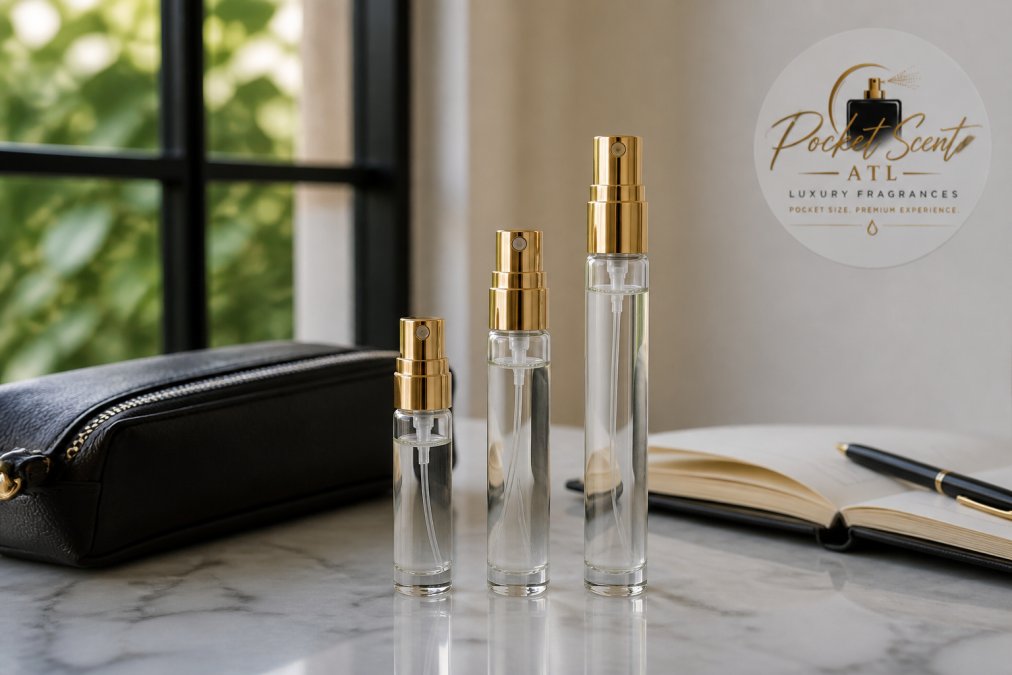
Concentration adds another layer. Eau de toilette, eau de parfum, and parfum contain different amounts of fragrance oil, which affects both how long a scent lasts and how much you need per wear. A 2 ml sample of a parfum may go further than the same volume of an eau de toilette.
For anyone building a collection from scratch, a discovery set is the most efficient starting point. Pocket Scent ATL's Build Your Own Five-Scent Discovery Box lets you choose five fragrances, each arriving as a 2 ml glass sample spray in gift-ready packaging. It is roughly 10 ml of fragrance in total, spread across five different scents.
Exploring Fragrance Families Without Full-Bottle Commitment
Fragrance families are the broad categories that describe how a scent is built: fresh, floral, woody, oriental, gourmand, and aromatic, among others. Samples let you explore those families without buying a full bottle from each one.
This is where most beginners get stuck. You read that you love woody fragrances, so you buy a woody bottle. Then you discover you actually prefer woody scents with a sweet base, or citrus on top, and the bottle you bought sits untouched.
Sampling across families fixes that. Try a [fresh citrus like Dolce & Gabbana Light Blue](https://pocketscentatl.com/products/dolce-gabbana-light-blue-for-women-luxury-womens-summer-fragrance-copy), which pairs Sicilian lemon and apple with a soft woody base. Then try something warmer, like Asad Elixir, with its pink pepper, saffron, and tobacco heart. The contrast teaches you more in a week than months of reading reviews.


Middle Eastern fragrances deserve a special mention here. They often lean richer and sweeter than their designer counterparts, and they are worth testing rather than assuming. A gourmand like Lattafa Yara Elixir, with its strawberry s'mores opening and caramel base, sits at the opposite end of the spectrum from a crisp citrus scent. Both can be excellent. Only your skin can tell you which one is yours.
How to Store Perfume Samples So They Last
Storing perfume samples correctly means keeping them cool, dark, and upright. Heat, light, and air are the three things that degrade fragrance over time, and a sample vial is more exposed to all three than a sealed bottle.
The best spot is a drawer, a closet, or a dedicated box away from windows. A bathroom shelf is the worst option, even though it is where most people keep their bottles. The repeated temperature swings from hot showers speed up the breakdown of top notes.
Keep vials upright so the liquid does not sit against the seal. If you are storing samples for months, a small airtight container with a lid adds another layer of protection.
Shelf life varies by concentration and storage conditions, so there is no single number that applies to every fragrance. If a sample smells dull or sharp after a year in a warm room, storage is usually the culprit, not the fragrance itself.
Building a Signature Scent One Sample at a Time
A signature scent is not found in a single shopping trip. It is built through repeated testing, and samples are the raw material.
The process is straightforward. Test broadly across fragrance families until patterns emerge. Narrow down to the two or three scents you reach for most often. Then buy a travel spray of your favorite and live with it for a month before committing to a full bottle.
That last step matters more than people expect. A scent that delighted you in spring may feel heavy by August. A 10 ml travel spray bridges that gap. It gives you enough fragrance to wear regularly while you decide whether the full bottle earns its place on your shelf.
For anyone who wants a shortcut, a curated set does the sorting for you. Pocket Scent ATL's discovery box and individual samples are designed for exactly this, and the men's and women's collections cover designer, niche, and Middle Eastern options.
A fragrance wardrobe built this way costs less than one mistaken blind buy. It also tends to be one you actually wear, because every bottle in it was earned.
What to Look for When Choosing Samples
Not all sample programs are equal, and a few details separate a useful sample from a wasted one. Check the concentration and the format before you buy, and confirm how the fragrance was decanted.
Independently rebottled decants, like the ones Pocket Scent ATL prepares from authentic, legally acquired retail fragrances, are clearly labeled as such and are not original manufacturer bottles. That transparency matters. It tells you exactly what you are getting.
Consider the size against your goal. If you are testing, 2 ml is enough. If you already know you love the scent and want it for travel, a 10 ml travel spray is the practical choice. If you are buying a gift, a build-your-own discovery box covers more ground than a single vial.
Frequently Asked Questions
Are perfume samples worth the investment?
Perfume samples let you test a fragrance on your skin across multiple wears before committing to a full bottle. Since skin chemistry, weather, and occasion all change how a scent develops, a sample shows you the dry down and longevity in real conditions. At Pocket Scent ATL, samples start at $4.99, so you can try several fragrances for less than the cost of one full bottle you might not love.
How do perfume samples help you avoid blind buy mistakes?
A blind buy means purchasing a full bottle based only on reviews or notes lists. Samples remove that guesswork. You wear the fragrance on your skin, observe how the top notes shift into heart and base notes, and decide whether the projection and longevity suit you. Avoiding blind buy regret is one of the clearest benefits of buying perfume samples, especially for expensive designer or niche scents.
How many wears can you get out of a 2ml perfume sample?
A 2 ml sample provides enough fragrance for several wears, allowing you to test a fragrance in different settings, seasons, or times of day. If you want more wears before deciding, a 10 ml travel spray offers significantly more applications.
How does skin chemistry affect how a perfume sample smells?
Skin chemistry, including your natural oils, body temperature, and pH, influences how a fragrance develops once applied. A scent that smells bright and citrusy on one person may lean warmer or sweeter on another. That is why testing a sample on your own skin matters more than smelling it on paper or on someone else. Give each sample a full wear day before judging it.
Finding a scent you love takes trial, and trial works best in small doses. Pocket Scent ATL makes that easy with 2 ml samples, 10 ml travel sprays, and full-size bottles of authentic designer and Middle Eastern fragrances, plus expert guidance if you are not sure where to start. Sample first, wear it for a week, and let your skin make the decision. Explore the collection and find your signature scent.
0 comments